I need to make it to a top law firm.
Something like, a litigation attorney at an AMLAW 100.
Is this firm ranked?
Is this industry prestigious enough?
Is this paying enough? Let me check Vault.com and see what my peers are making.
What will people think?
How can I update my LinkedIn to show I’m moving up?
These were the thoughts that consumed my mind over the past five years. At some point, I had to slow down—because I was driving myself crazy. I hadn’t even taken the time to sit down and ask myself, “What do I want?”
Sure, I wanted to be perceived as successful. But why was I allowing others to define what success looked like for me?
So, how did I learn to stop letting my job define me? Truthfully, I’m still learning. But quitting my job at a ranked law firm was my first step. The harder step came next: I had to face myself. I had to shed the layers of expectation and the fear of how I would be perceived without the title.
As a Black, first-generation Haitian-American woman, perception has shaped my entire experience. I have always been conscious of how I’m seen.
I remember attending a prestigious Catholic school in Port-au-Prince, Haiti where specific dress codes and formalities were required. I come from a Haitian family that values being proper, educated , well-groomed, and well-mannered. I even was taught etiquette before kindergarten to learn how to use specific utensils at formal dinner tables.
Then, migrating to the U.S., a new layer was added: I was no longer just Haitian, Catholic, or the youngest sibling—I was also now Black. A color that I never noticed while living in a majority Black country. I quickly became aware of how people responded to me based on how I dressed, who I spoke to, how I presented. I saw that perception influenced opportunity.
If I looked polished at school, teachers invested in me through time, attention, and educational opportunities. If I didn’t, I was overlooked.
So I wore the “mask” of what was proper, what was safe, what was accepted.
That instinct followed me into adulthood. It’s why I chose Wake Forest, because I knew it held weight in the Southeast when I would look for job opportunities. I chose internship roles that made me look successful. Unbeknownst to myself, I went after what would impress others. But somewhere along the way, I stopped asking: What does Marsha want? Or, maybe I asked and the answer was buried under how I wanted to be perceived.
After several years of practice, I finally quit my job, left Atlanta, packed my things into storage, and moved back home to Florida. I spent time with my family and saw people who didn’t know me as “Marsha the lawyer.” That’s when the unraveling began.
When people asked what I did for a living, I often stuttered. “I’m a lawyer,” I’d say, even though I was unemployed and knew I disliked many things attached to the title. Other times I’d say, “I’m unemployed,” which made conversations awkward. People often didn’t ask further, and I’d feel compelled to over-explain that I left voluntarily… which raised more eyebrows.
I felt completely raw without the shield of a job title.
During this sabbatical, I first traveled to Washington D.C., South Florida, Panama. I became more used to the question: What do you do? Sometimes, I’d say, “I’m a writer,” since that’s what lawyers do anyway. Other times, I’d say, “I read for work.” Which, was also true. The more I distanced myself from the label, the more space I created to reconnect with my self.
My most life changing experience during the time was traveling to Ghana. It genuinely changed my perspective on life. Being there, unemployed, with my partner, was liberating. It felt freeing to exist without being “othered,” perhaps because I was in a country full of people who looked like me. I could wear bright red cornrow braids down to my hips without feeling diminished or judged for my expression. I was still smart, driven, and thoughtful, just with red hair. That may sound small, but for Black women in the corporate legal world, creative hair expression is often stifled to maintain respectability in white spaces. In Ghana, however, no one cared about my job title. I had value simply by existing. I felt creative freedom for the first time in a long time, and I refused to let go. You see, I used to think lawyers had to be one way, but in Ghana, I discovered I could be any way that aligns internally.
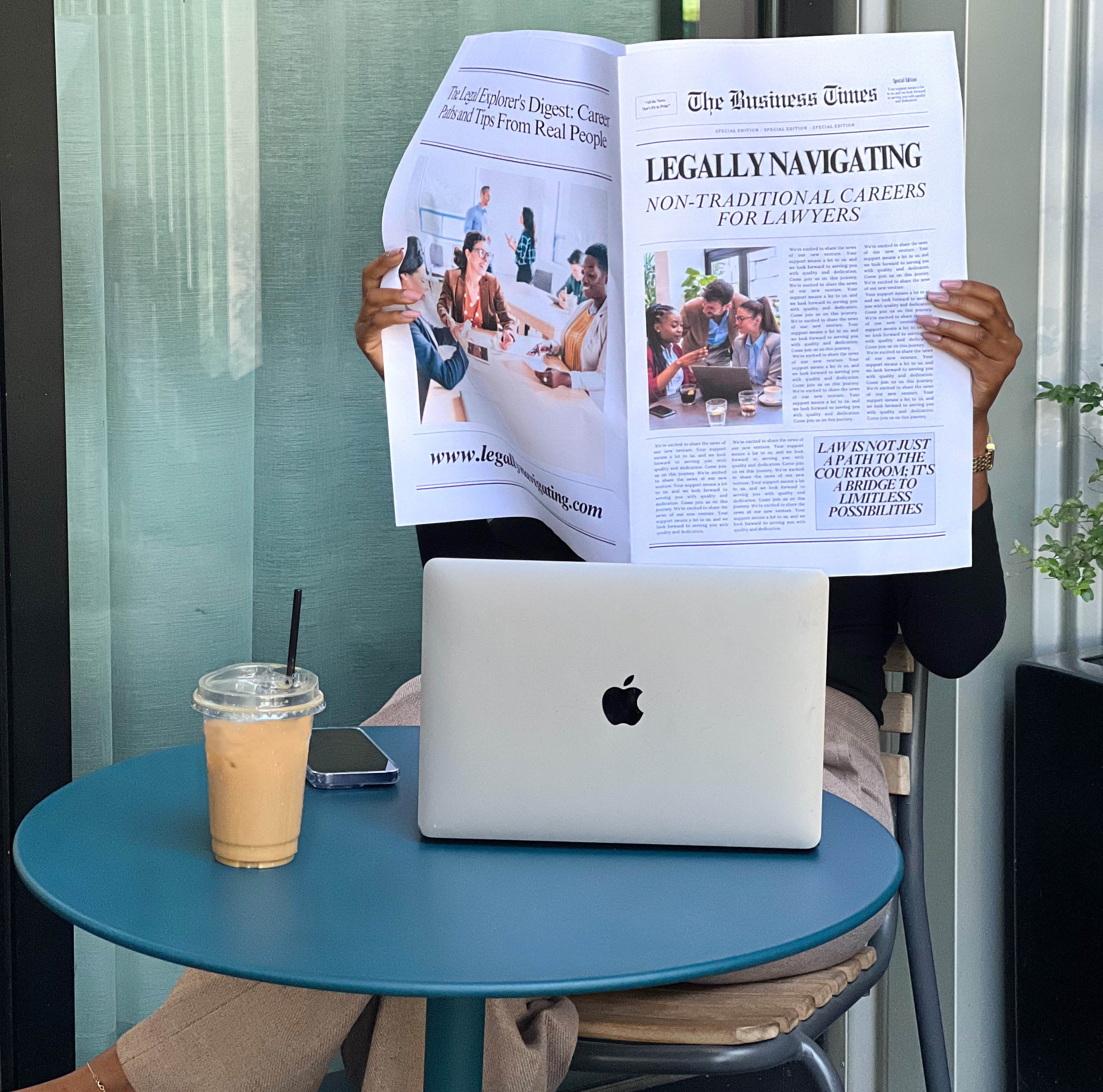
When I returned to the U.S. several weeks later, I started job hunting. However, I wasn’t practicing what I’d just discovered. I was still chasing the “right” titles. After five years as an attorney, I believed I should be pursuing roles like:
- In-House Counsel
- Legal Consultant
- Litigation Attorney at an AMLAW firm
- Legal Advisor
- Legal Counsel
But after countless interviews, redirections, offers, and gut checks, I realized… something was not right.
Then came a curveball: A recruiter contacted me about a role I hadn’t considered—Senior Claim Director (Employment). I almost said no. I felt like I’d be “settling,” like I wasn’t doing “enough.” The old thoughts returned:
Is this prestigious enough?
Is this paying enough?
What will people think?
Will it look good on LinkedIn?
But I needed a job. And the role intrigued me. So, I said yes.
That’s where my faith kicked in. I took the role, and somewhere between the recruiter call and my first day, I felt an internal ease. The first few months, I was not sure of where I landed. What I did not expect was to keep shedding skin and confronting myself. But I always felt like I was right where I needed to be.
I love what I do now, and that is something I couldn’t always say before. This role has shown me perspective I did not know I was missing, and opened doors to opportunities I am still discovering. I’m grateful.